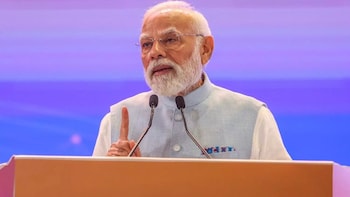
Only time will tell when a rate cut will happen, says RBI Governor Shaktikanta Das.
On the Paytm action, Das says the regulations are robust, and this was not a case where there was regulatory deficiency.
Paytm issue is one of compliance related to various aspects, says Das.
Deputy Governor Michael Patra clarifies on whether government’s GDP projection is optimistic.
What goes into nominal GDP is GDP deflator
GDP deflator is always a combination of CPI, WPI
WPI has been in deflation for most part of this year, and is just emerging from it
Alert: Nominal GDP projected at 10.5%, with real GDP seen at 7% in FY25
There is still time for customers to access services of Paytm, RBI Deputy Governor Swaminathan J.
Very difficult to provide hypothetical answers at this time.
We keep customer at the centre of what needs to be done.
Each bank has to take their own business decisions with respect to partnership with Paytm.
CBDC could result in more focused use of government's direct benefit transfers, says Governor Shaktikanta Das.
Deputy Governor Ravishankar clarifies about fungibility in use of CBDC, in response to a question by NDTV Profit's Vishwanath Nair.
"When a family puts some currency notes in a package to be used for groceries. This doesn’t mean that the fungibility is lost. It just means that for that duration the money can’t be used for any other purpose."
RBI is and will continue to support innovation and technology in the financial sector.
Let there not be any doubt about RBI’s commitment to promote fintechs, innovation, technology.
We have been engaged with the entity for quite some time.
Not appropriate to share granular details on Paytm issue.
Restrictions are always proportionate to the gravity of the situation, says Shaktikanta Das.
Individual entities should be mindful of these aspects for long-term success.
All actions of RBI are in best interest of systemic stability, protection of customers’ interest.
Will be issuing FAQ some time next week on Paytm issue
My comments relate to all regulated entities including Paytm, says Das.
We have significantly deepened supervisory systems, approach and methods.
Emphasis is always on bilateral engagement with regulated entity.
We are completely focused on nudging regulated entity to take remedial action.
Sufficient time is given for taking corrective action.
When constructive engagement doesn’t work we go for imposing business restrictions.
We have various tools available to us, says Deputy Governor Swaminathan on Paytm action.
A one-size-fit-all action doesn’t work, he says, adding that tools are deployed based on certain conditions.
There is no worry about the system at the moment, RBI Governor Das says on Paytm. "We are talking about a specific payments bank."
We will work on feedback we have been getting, Deputy Governor Swaminathan further says on Paytm saga.
We will ensure customer inconvenience, if any, is minimised, he says.
We give sufficient time to every regulated entity to comply with requirements, RBI Governor Das says.
We don’t comment on individual entities, says Deputy Governor Swaminathan J on the Paytm saga.
This is a supervisory action on regulatory entity for persistent non-compliance.
Supervisory action is usually preceded by months of bilateral conversations.
Incumbent on regulator to protect interest of ultimate consumer.
CONTEXT: Reserve Bank of India had imposed strict restrictions on Paytm Payments Bank on Jan. 31.
Stance is about future course of policy rates, says Deputy Governor Michael Patra.
Liquidity is endogenous to the rate.
We have to move liquidity to achieve a certain rate.
Objective is to keep weighted average call rate around repo rate.
RBI Governor Shaktikanta Das lists the key announcements from the monetary policy decision.
Domestic economic activity remains strong; real GDP growth seen at 7% in FY25.
CPI inflation is moderating with intermittent spikes; must remain vigilant.
Globally markets are front-running central banks in anticipation of policy pivots.
Central banks remain apprehensive, await more durable signs of lower inflation.
Liquidity to be actively managed by RBI.
Multi-pronged policies have worked to maintain financial stability.
Systemic, sectoral, institutional signs of stress are being monitored, acted on.
Good governance, robust risk management, sound compliance culture, protection of consumer interest are hallmarks of RBI’s approach.
Regulated entities must accord highest priority to these aspects.
External sector of economy remains resilient, CAD to be eminently management.
Exchange rate of Indian rupee has remained stable.
Governor Shaktikanta Das reaffirms commitment to bring inflation down to 4% target. He reiterates that endeavour has been to keep economy in balance.
Propose to enable additional programmability and offline capability in e-rupee payments, says Governor Das.
To put in place a principal-based framework for authentication of digital transactions.
SMS-based OTP has become very popular.
Alternative authentication mechanisms for payment have emerged.
To streamline onboarding of customers on AEPS system to increase transparency, control frauds, says Governor Shaktikanta Das.
Alert: AEPS is Aadhaar Enabled Payment System.
RBI extends key fact statement requirements for all retail and MSME loans.
CONTEXT: Earlier RBI had mandated key fact statement only for a certain class of lenders.
Revised regulatory framework for electronic trading platforms to be issued for shareholder feedback, says Governor Das.
The framework will allow resident entities to hedge price of gold in OTC segment in IFSC, he says.
Current account deficit for FY24 and FY25 to continue to remain eminently manageable, says Das.
Forex reserves stand at $622.5 billion.
Confident of meeting all external commercial requirements.
Domestic financial system remains resilient, says RBI Governor Shaktikanta Das.
Regulated entities must accord highest importance to good governance, robust risk management, sound compliance culture, protection of customer interest, he says.
Will deploy appropriate mix of interest rate instruments to maintain financial stability, says Governor Das.
As of Feb 7, Indian rupee remained stable compared to emerging market peers and few advanced economies.
Indian rupee exhibited lowest volatility in FY24.
Exchange rate is market determined.
Relative stability of rupee, despite stronger US dollar, reflects strength, stability of economy.
Confluence of multiple factors ensured that rupee remained stable over the last one year.
Have done two-way market interventions through repo, reverse repo, says Governor Shaktikanta Das.
RBI continues to be nimble, swift in response to evolving liquidity conditions.
Stance on withdrawal of accommodation must be seen in context of incomplete transmission and inflation.
System level liquidity turned into deficit in September, says Governor Shaktikanta Das.
Potential banking system liquidity still in surplus.
Seeing pick up in government spending in second fortnight of Jan and in February.
RBI undertook 6 VRRR auction between Feb 2-7 to absorb excess liquidity.
While short-term rates have fluctuated, long-term rates are stable.
Monetary transmission in credit market remains incomplete.
The job is not yet finished, says RBI Governor Shaktikanta Das.
Need to be vigilant on new supply shocks.
Headline inflation remains high with considerable volatility this year.
CPI inflation target of 4% is yet to be reached.
Monetary policy has to remain vigilant to navigate last mile of disinflation.
Last mile of disinflation is always the most challenging.
Stable inflation at 4% will provide necessary bedrock for long-term growth.
Adjusted for government cash balances, potential liquidity in system is still in surplus.
CPI inflation seen at 5.4% for FY24, and at 4.5% in FY25, says Shaktikanta Das.
CPI inflation in Q1 at 5%, 4% in Q2, 4.6% in Q3, and 4.7% in Q4.
Inflation projections are based on assumption of normal monsoon.
Decline in core inflation has continued to be broad-based.
Inflation trajectory would be shaped by outlook on food inflation.
There is considerable uncertainty about food inflation.
Increasing geo-political tensions leading to supply-chain shocks.
Prices of key vegetables are witnessing seasonal price corrections.
FY25 real GDP growth seen at 7%, says RBI Governor Shaktikanta Das.
Real GDP growth seen at 7.2% in Q1, 6.8% in Q2, 7% in Q3, and 6.9% in Q4.
Buoyant demand for residential housing, increased thrust on govt capex seen boosting construction.
Rural demand continues to gather pace.
Strengthening farm-level activity should further support rural consumption.
Urban consumption remains strong.
Investment cycle is gaining steam on sustained government capex.
Domestic economic activity remains strong with real GDP growth projected at 7.3% for FY24, says Shaktikanta Das.
Indian government adhering to path of fiscal consolidation.
This is third successive year of growth of above 7%.
Momentum of economic activity is expected to continue in FY25.
Agri activity is holding up well despite headwinds.
Rabi sowing has surpassed last year’s level.
Industrial activity is gaining steam on improved manufacturing.
Reducing debt burdens important to reduce fiscal stress, says RBI Governor Shaktikanta Das.
Global public debt to GDP ratio expected to reach 100% by end of decade.
Public debt levels in advanced economies much higher than those in emerging markets.
Elevated levels of public debt is raising concerns on macro stability in many economies.
Global growth expected to remain steady in 2024, even as global trade momentum remains weak, says Shaktikanta Das.
Global trade likely to grow faster in 2024.
Financial markets are volatile as participants adjust expectations.
Global central banks remain cautious against premature easing.
Elevated levels of public debt is raising concerns on macro stability in many economies.
MPC must continue to be actively disinflationary, says Shaktikanta Das.
Headline inflation rose to 5.7% in December 2023
Higher inflation in recent reading was on account of food inflation
Uncertainty in food prices continue to impinge on trajectory of headline inflation
Moderation in core inflation continued in goods and services
Transmission of 250 bps policy hike is still underway
MPC to carefully monitor any signs of generalisation of food inflation
MPC voted with 5-to-1 majority to keep repo rate unchanged at 6.5%, says Governor Das.
MPC voted to remain focused on withdrawal of accommodation.
MPC voted to keep stance unchanged with 5-to-1 majority.
Read the detailed story here.
RBI Governor says
In the first policy statement of 2024, Governor Shaktikanta Das says RBI enters 90th year of existence on April 1.
RBI has established itself as a credible institution
RBI has become pioneer in fostering innovation, technology in financial system
Higher Core Elements In Inflation Could Narrow Scope For Monetary Easing
"We maintain our view that the RBI MPC will keep the policy rate unchanged at the Feb. 8 policy meeting at 6.50%, sound optimistic on growth, recognise the sharp fiscal consolidation in the interim budget, and reiterate the commitment to the 4% headline inflation target, stated a research note by Goldman Sachs.
While the RBI is likely to keep policy settings unchanged, the tone is likely to be less hawkish, said Rahul Bajoria, chief economist at Barclays.
"We see a window for rate cuts opening in Q1 FY25," he said.
Essential Business Intelligence, Continuous LIVE TV, Sharp Market Insights, Practical Personal Finance Advice and Latest Stories — On NDTV Profit.