(Bloomberg) -- The European Central Bank mustn't allow inflation to remain above 2% into 2026, Governing Council Martins Kazaks said after projections showed that target will now only be met toward the end of next year.
While uncertainty remains high, policymakers are confident as things stand that disinflation is proceeding, allowing them to make monetary policy less restrictive, the Latvian central-bank chief said in an interview. But that would change if price pressures were to prove more stubborn, he warned.
The ECB's latest quarterly outlook sees inflation hitting 2% in the fourth quarter of 2025 — three months later than predicted in March. While some recent data on prices and wages raised questions about progress toward that goal, the ECB pressed ahead with a pledge to lower interest rates last week, taking the deposit rate down to 3.75% from its record 4%.
“Currently I think we are still on the path to 2% in the second half of 2025, and I would really hope that we would do it by that time,” Kazaks said in Dubrovnik, Croatia, where he's attending a conference.
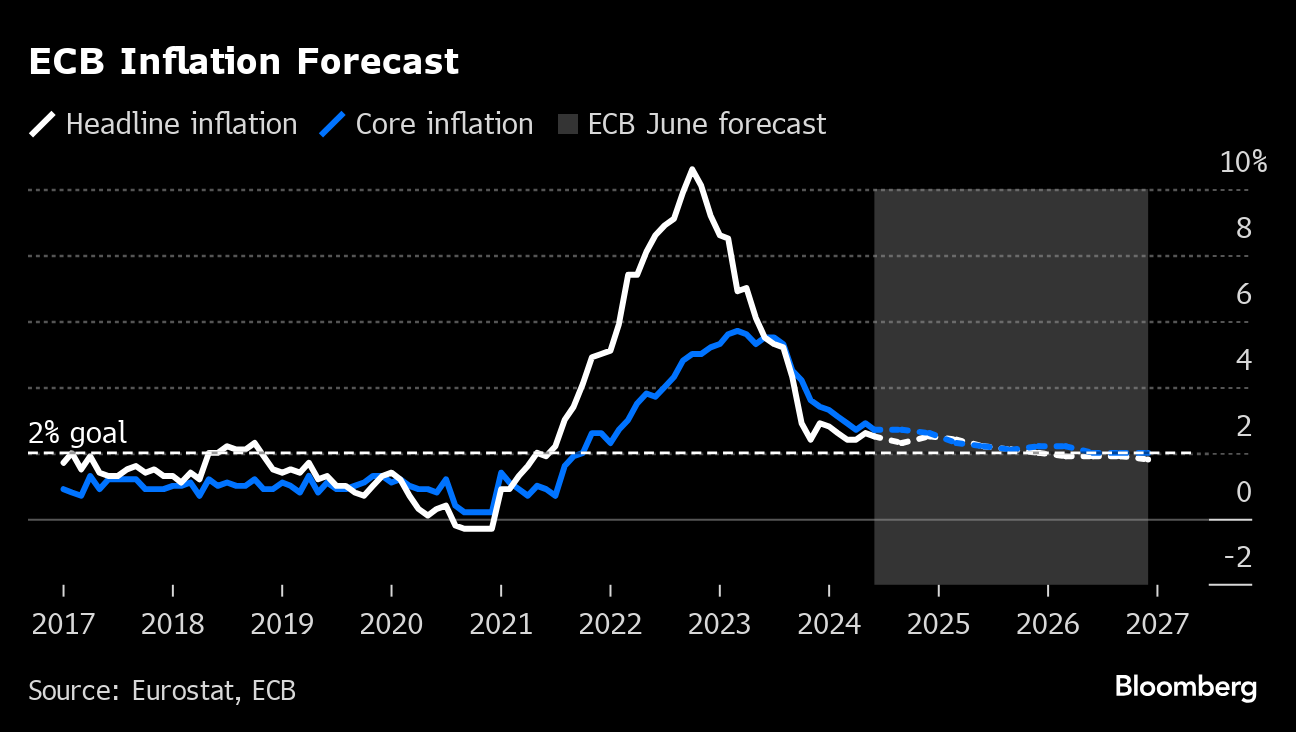
“We should not drag this problem into 2026,” he said. “If data show that reaching our target is being pushed out beyond 2025, then of course the restriction level needs to be maintained for longer so that we can avert those kind of outcomes.”
Policymakers led by President Christine Lagarde say economic data will determine the path of rates, with most wary to speculate how quickly borrowing costs will be reduced. Speaking separately to Bloomberg, Portugal's Mario Centeno urged prudence, while his Slovenian counterpart, Bostjan Vasle, said rates won't be lowered at the same rapid pace they were lifted.
“Disinflation is there,” Kazaks said. “Of course, uncertainty remains high. But we are still within our baseline scenario, which at the current moment allows for some easing of restriction. Can we remove all the restriction? No.”
He argued that last week's decision was correct — and that he'd have also taken it had the ECB not offered such clear guidance.
Kazaks cautioned against reading too much into single pieces of economic data, reiterating the ECB's mantra that the road to 2% will be bumpy.
“If there are consecutive data points that are showing that it's going a different way, then this is of course much more serious,” he said. “f you remove geopolitical and other external shocks, then in my view, disinflation could be derailed by an external shock, rather than current internal economic processes.”
Officials will remain open-minded and flexible, and would “of course” increase rates if circumstances demanded, Kazaks said.
“But currently, barring major external shocks, the path is down — it's clear,” he said.
More stories like this are available on bloomberg.com
©2024 Bloomberg L.P.
Essential Business Intelligence, Continuous LIVE TV, Sharp Market Insights, Practical Personal Finance Advice and Latest Stories — On NDTV Profit.