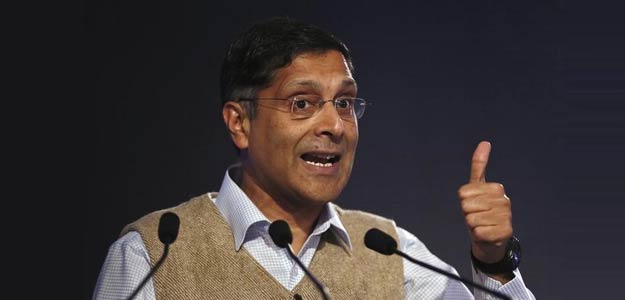
New Delhi: The Finance Ministry Committee, headed by Chief Economic Advisor Arvind Subramanian, has listed several risk factors, including revenue shortfall and re-emergence of trust deficit between the Centre and the states, on implementing GST (Goods and Services Tax).
The committee has suggested a low revenue neutral rate (RNR) of 15 per cent which could translate into bulk of the goods being taxed at 17-18 per cent, with a low rate of 12 per cent on merit goods and high rate of 40 per cent on demerit or 'sin' goods.
"One risk of setting an RNR that is low is the re-emergence of a trust deficit between the Centre and the States as happened in relation to compensation for lost CST revenues after the global financial crisis," the report said.
It further observed that revenue shortfall could result in a "double whammy" for Centre as it would also affect the fiscal deficit and might delay compensation to the states, resulting in "trust deficit".
The revenue shortfall, the Chief Economic Advisor Arvind Subramanian-headed Committee said, could be overcome by raising taxes on non-GST products like petroleum, alcohol and tobacco.
The Centre may also relax the deficit targets, the report said, adding, "A moderately higher fiscal deficit due to a low GST will benefit consumers, especially poorer ones."
It said that given the "unavoidable teething troubles" that will afflict GST implementation, it would be advisable to keep rates lower lest it should increase "taxpayer displeasure, reduce compliance and increase disaffection".
"On balance, lower rates will facilitate compliance. The econometric analysis suggests that a one percentage point reduction in the standard rate will lead to an improvement in administrative efficiency (and compliance) of one percentage point which in the GST setting would translate into an efficiency gain of about 15 per cent," the report said.
It further said a lower rate will be seen as more politically acceptable and will help taxpayer compliance.
As regards the price consequences of Goods and Services Tax (GST), the report said it would be "small" especially under a dual rate structure with essential food items exempted.
However, it added that revenue neutrality may not be enough to guarantee that there will be no price impact across all categories of goods and services.
As per the analysis, the report said, an RNR in the 15-15.5 per cent range with a lower rate of 12 per cent and a standard rate of 18 per cent would have no aggregate inflation impact.
Essential Business Intelligence, Continuous LIVE TV, Sharp Market Insights, Practical Personal Finance Advice and Latest Stories — On NDTV Profit.