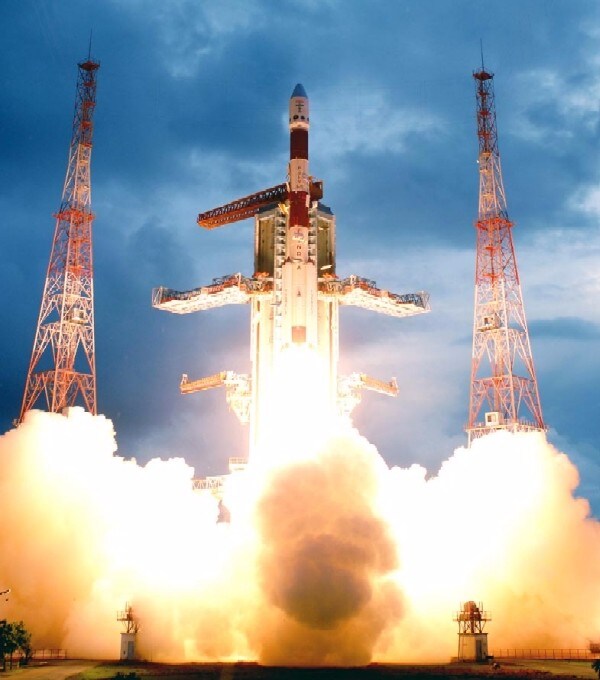
India's first lunar probe – the Chandrayaan-1 spacecraft – which was considered lost, is still orbiting the Moon, NASA scientists found through the use of a new ground-based radar technique.
Indian Space Research Organisation (ISRO) lost communication with the Chandrayaan-1 on August 29, 2009, almost a year after it was launched on October 22, 2008. Now, scientists at NASA's Jet Propulsion Laboratory (JPL) in California have successfully located the spacecraft, still circling some 200 kilometres above the lunar surface.
"Finding LRO was relatively easy, as we were working with the mission's navigators and had precise orbit data where it was located. Finding India's Chandrayaan-1 required a bit more detective work because the last contact with the spacecraft was in August of 2009," said Marina Brozovic, a radar scientist at JPL and principal investigator for the test project.
The Chandrayaan-1 spacecraft is very small, a cube about 1.5 metres on each side - about half the size of a smart car. Although the interplanetary radar has been used to observe small asteroids several million miles from Earth, researchers were not certain that an object of this smaller size as far away as the Moon could be detected, even with the world's most powerful radars.
Chandrayaan-1 proved the perfect target for demonstrating the capability of this technique.
To find a spacecraft 3,80,000 kilometres away, JPL's team used NASA's 70-metre antenna at NASA's Goldstone Deep Space Communications Complex in California to send out a powerful beam of microwaves directed towards the Moon. Then the radar echoes bounced back from the lunar orbit were received by the 100-metre Green Bank Telescope in West Virginia.
Finding a derelict spacecraft at lunar distance that has not been tracked for years is tricky because the Moon is riddled with mascons (regions with higher-than-average gravitational pull) that can dramatically affect a spacecraft's orbit over time, and even cause it to have crashed into the Moon.
JPL's orbital calculations indicated that Chandrayaan-1 is still circling some 200 kilometres above the lunar surface, but it was generally considered "lost." However, with Chandrayaan-1, the radar team utilised the fact that this spacecraft is in polar orbit around the Moon, so it would always cross above the lunar poles on each orbit.
On July 2 last year, the team pointed Goldstone and Green Bank at a location about 160 kilometres above the Moon's north pole and waited to see if the lost spacecraft crossed the radar beam.
Essential Business Intelligence, Continuous LIVE TV, Sharp Market Insights, Practical Personal Finance Advice and Latest Stories — On NDTV Profit.