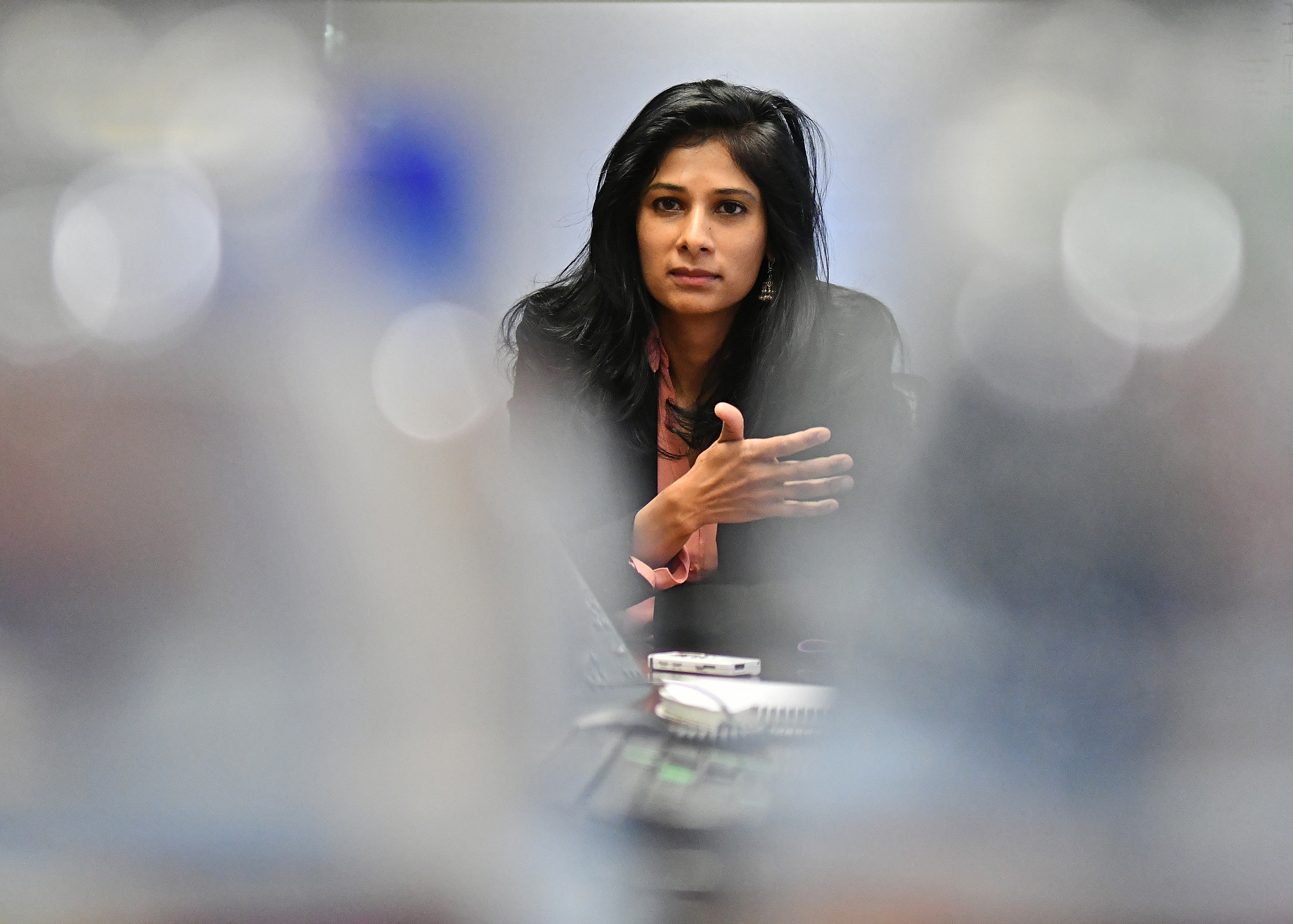
The International Monetary Fund's first female chief economist Gita Gopinath today flagged the risks associated with India's “high” fiscal deficit while refusing to comment on specific government policies.
“In the case of India what we flag is the fact that the overall consolidated fiscal deficit remains high and it has been the case for the last five years,” Gopinath said on the sidelines of the World Economic Forum in Davos, Switzerland. “We certainly need to fix that.”
The Indian-American economist's comments come when Prime Minister Narendra Modi's administration is said to be planning a cash handout to the country's distressed farmers. Bloomberg reported today the plan to give cash to farmers instead of subsidies will come at an additional cost of roughly Rs 70,000 crore to the exchequer annually.
However, India has already exceeded its fiscal deficit target. This means the government would have very limited fiscal space to boost spending in an election year.
Part of India's fiscal slippage risks come from the continued weakness in the goods and services tax collections, Gopinath said. “GST revenues haven't come in at the rate with which it was expected and that would be an area for continued improvement.”
Gopinath today unveiled the IMF's updated World Economic Outlook that paints a challenging future plagued with rising risks. Global growth is expected to slow to 3.5 percent in 2019 from 3.7 percent last year. “We've reduced the forecast in 2019. But it's important to note that the revisions are modest,” she said.
“What we're more concerned about are the growing risks to the global economy,” Gopinath said. “And there are several of those: an acceleration in trade tensions, a worsening in financial conditions, no-deal Brexit and in the event of a faster than expected slowdown in China the consequences of that for the global economy would be far more negative than what we have right now.”
Yet, India is set to remain insulated from them. The IMF expects India to remain the fastest growing major economy for the next two years, aided by lower oil prices and slower monetary policy tightening.
Watch the interview here:
Essential Business Intelligence, Continuous LIVE TV, Sharp Market Insights, Practical Personal Finance Advice and Latest Stories — On NDTV Profit.