Scan to Download
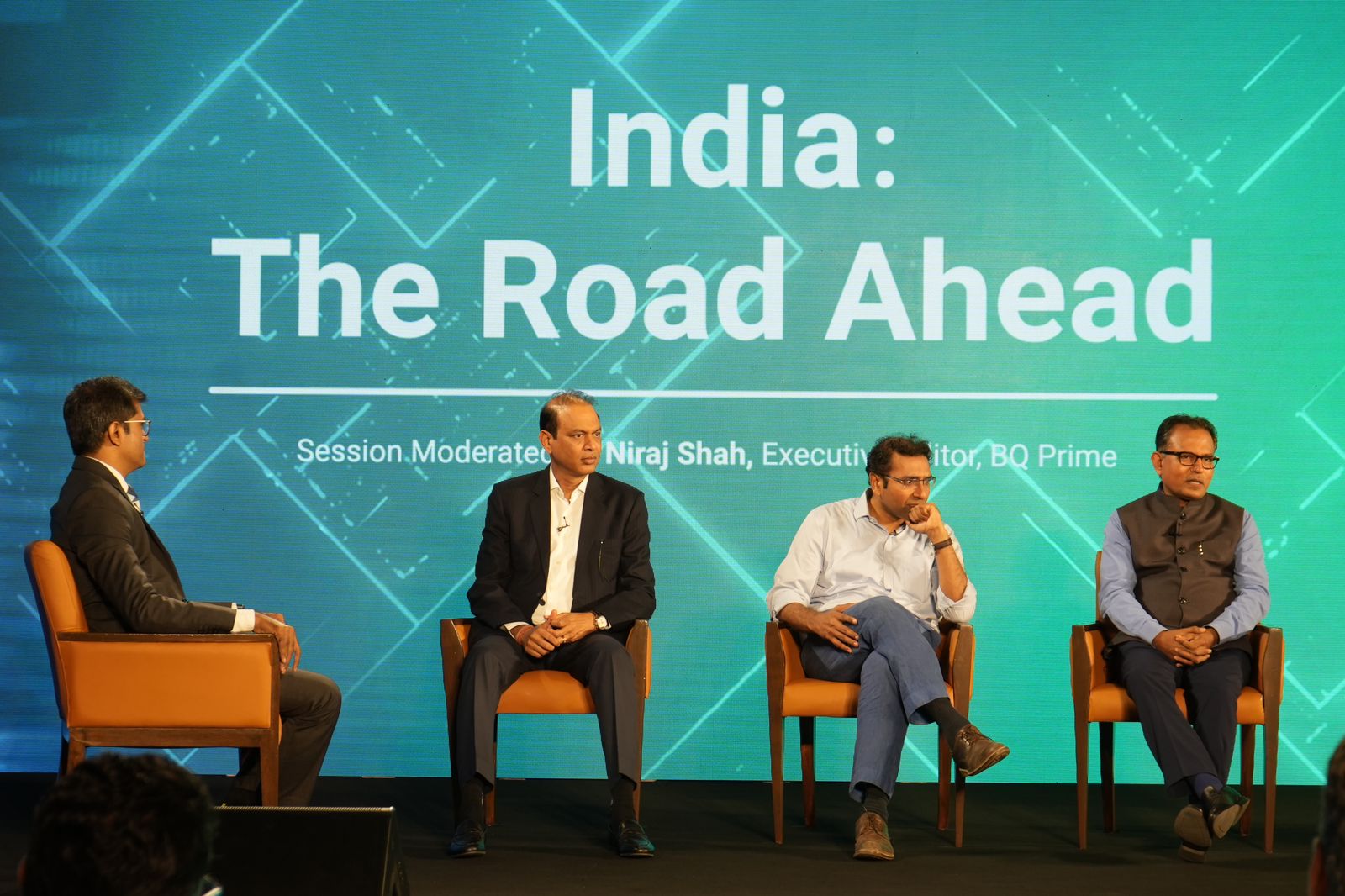
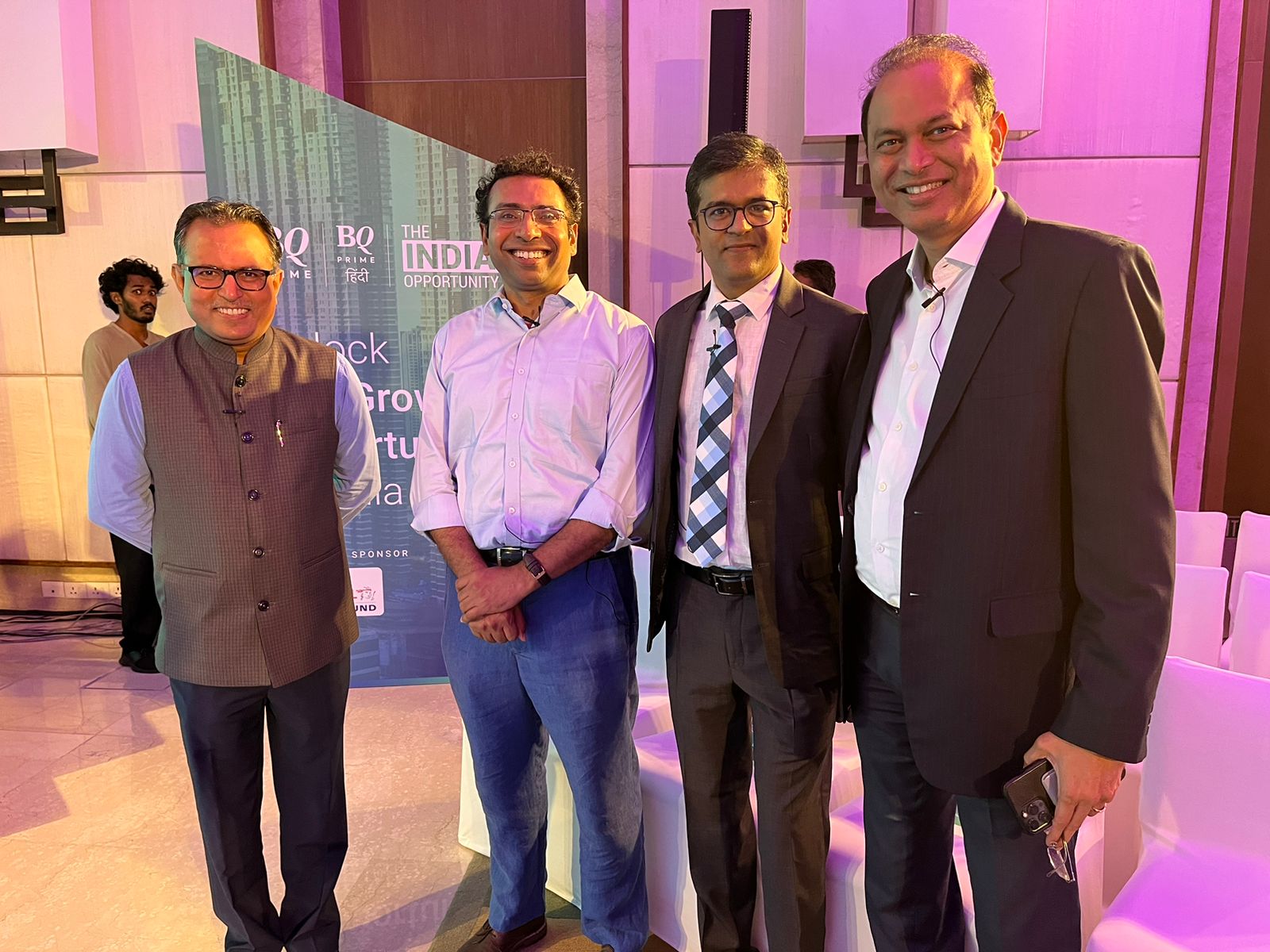
Thanks for tuning in to live coverage of BQ Prime's India Opportunity Summit from Mumbai.
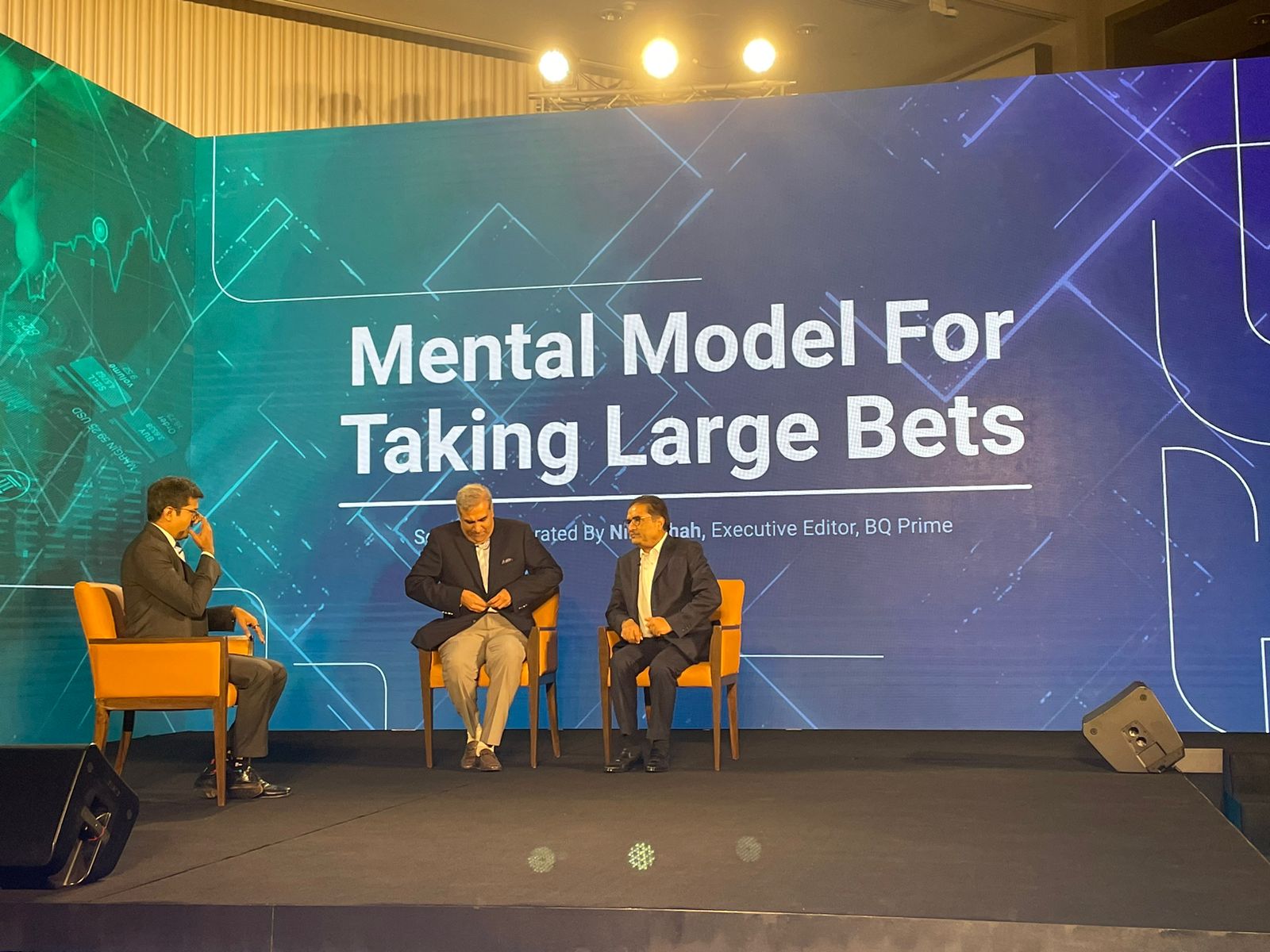
"You are young, like 25, and you want to take a bet and have 20 years of a golden period in India. This is the time to build business. In our times, stock market was pariah, now everyone wants to do that. The contrarian thing now is to build a business. The opportunity to own something 100% is better rather than just 2.5%. If I were you, I would be building a business."Manish Chokhani
When you have a fundamental pick and it’s going up, you shift focus to the technical, says Chokhani.
"My founder taught me not to sell on rising tops and rising bottoms. Instead, sell on the way down. When even a cab driver is giving you tips and no stock is too pricey, it’s a bubble and time to sell," Enam's Chokhani said.
India has compounding opportunities, says Raamdeo Agrawal.
"If you stay away from the market for 2-3 months, it may move and you may never catch it. Remaining 100% invested is what has worked for me," he said.
This business for me is a lesson in humility. Each time you make a mistake or think supersmart, you get whacked by the market. You take the previous lesson, dust your shoes and walk on and find the next field to conquer and the next mistake to make.Manish Chokhani
Bajaj Finance was relentless for 16 years. To give money is every easy, anyone can do it. Now people are giving it in 10 seconds. What is the rigour? Algorithm can’t do your collection. Where do I want to target, what pricing, what costing, what is the risk metric… It’s all about execution rigour. It’s those companies that become wealth creators.Manish Chokhani
We bought Eicher as a truck company but it became a phatphatia (motorcycle) company. We got a good business and a good management at a reasonable price.Raamdeo Agrawal
You bet on business and management tailwind, says Motilal Oswal's Raamdeo Agrawal.
"Business tailwind can be figured out through financial statements. You have to see if the management has competence and passion to grab the market share," he said.
"Can you walk a path that is different from others? If you are looking for fixed income, it’s not going to work. This (equity market) is an Ekla Cholo Re world. To have that independence of mind and have something that resonates with you. The approach to value investing and asymmetrical bets is common."Manish Chokhani
Real power comes from holding the investment, says Enam's Manish Chokhani.
"Most of us will get the bet size, identification of stocks right at some point. But ability to hold and see terminal value is the differentiator," he said.
Investment is very different from betting and is a long process, says Motilal Oswal's Raamdeo Agrawal.
"Keep allocation at a level where you don’t bother about it. I am a voracious buyer, and invest 2.5-3% of corpus on one bet," he said.
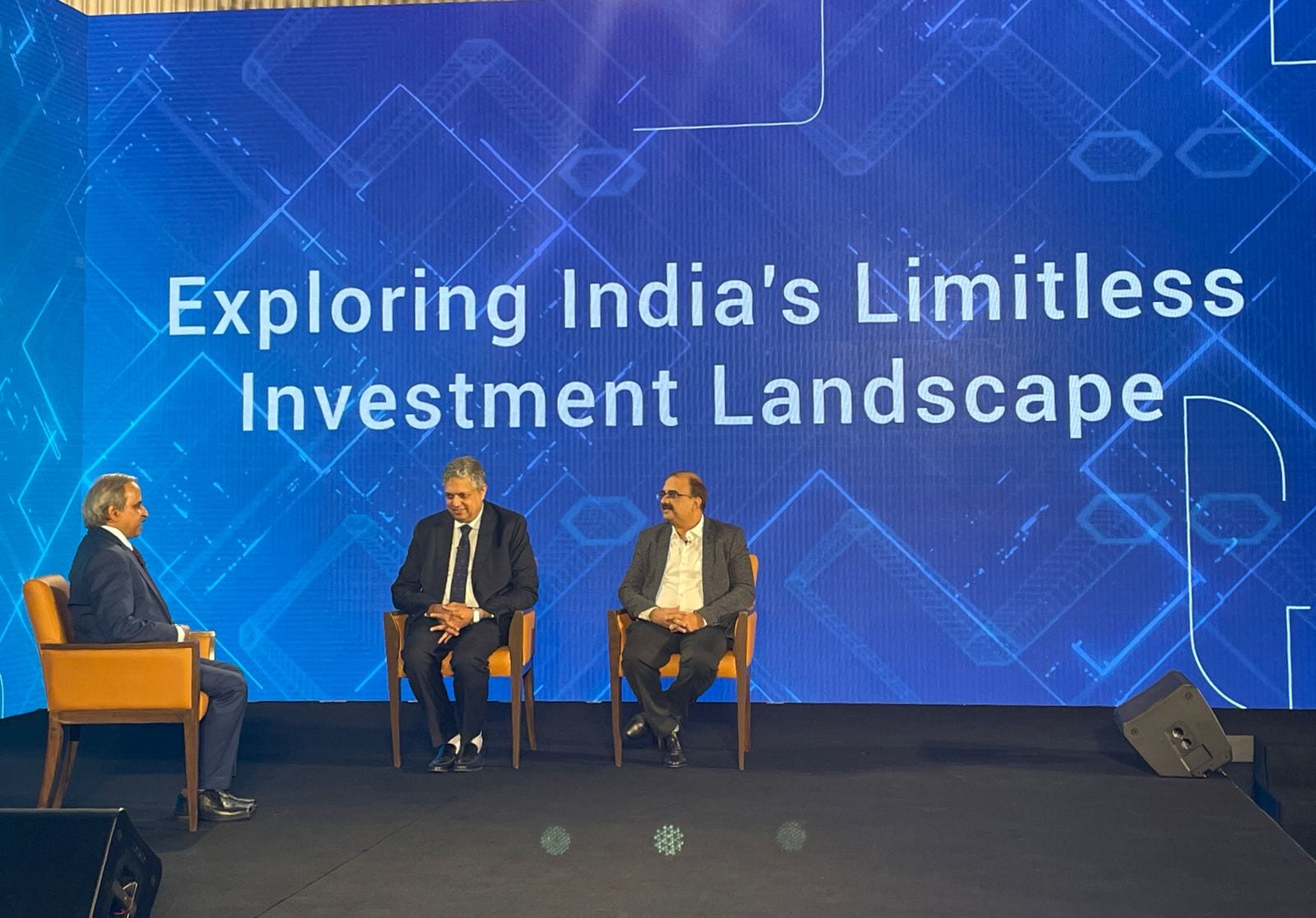
India is not in a boom phase in large caps but in small and mid caps, says S Naren.
"In boom phase, you don’t make money in the medium term," he said.
What attracts media attention is not the houses that sell for Rs 20 lakh. A lot of players who come to the mutual fund industry talk about affordable housing. There was a lot of government subsidy given which gave it a huge fillip. Outside big cities, there is a fair amount of activity happening.S Naren
For the first six years, telecom changed my life but equity returns from the sector were negative. Only in the last four-five years, I got returns. Sometimes, innovation and stock markets are not necessarily linked.S Naren
Some of the mid-sized businesses are capable of latching on to large trends, says Nippon India Mutual Fund's Sailesh Bhan.
"About 80-90% of winners can come from mid-sized companies that are profitable and have managements to capture some of these trends," he said.
Investment opportunities being limited to two or three cities was correct 10 years back. There are big changes… and India is now more a bottom-up kind of a country with, maybe, 100 cities functioning and growing rapidly versus just three or four cities earlier.Sailesh Bhan
Increasing cement demand in the first quarter of this fiscal shows boom in building activity, says S Naren.
"Cement demand has been buoyant and it is a volume-based boom and not price-base. Construction activity is booming across the country and is not limited to tier 1 cities," he said.
Housing and urbanisation are extraordinary mega trends in India, according to S Naren.
"Need for more supply-side practices across the country. India needs to measure each state by the number of houses being built. It is a municipal subject and hasn’t seen enough supply-side initiatives," he said.
Services exports boomed during Covid as companies moved more business to India, according to S Naren.
"That resolved current account deficit, and aided employment and consumption. Free payments didn’t help companies make money, but consumers gained," he said.
Growing cohort of 50-plus people, manufacturing and investment opportunity three mega trends for India, says Sailesh Bhan.
"India has the fastest-growing cohort of people aged 50-plus. If manufacturing does not take off, we will miss a big opportunity. Just about 3-4% of India invests, and it can go to 10-12% in a decade," he explained.
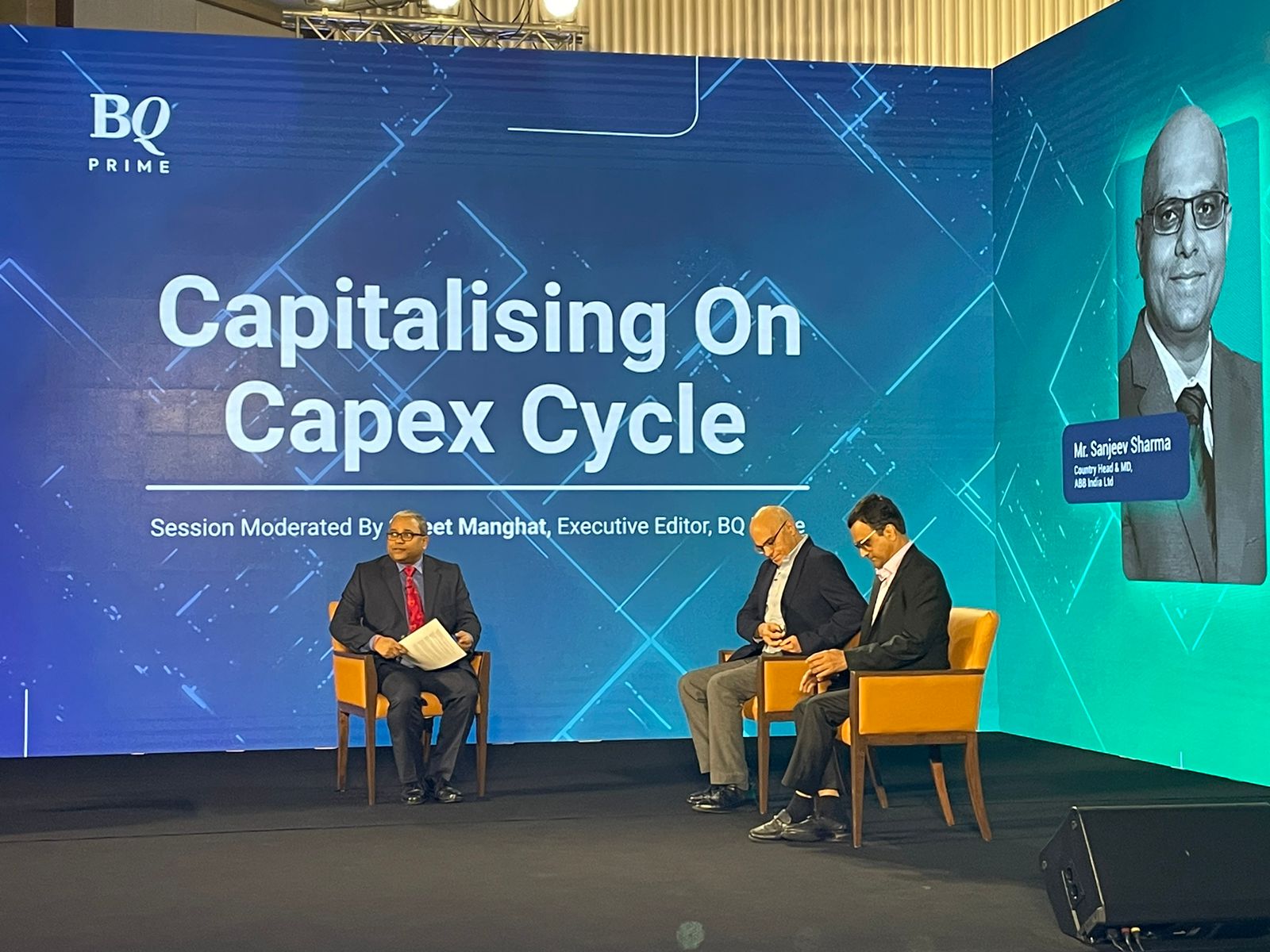
"If we continue to invest, bring new technology, continue to have larger themes like energy transition and manufacturing, and keep a stable policy, it will be a multi-decadal opportunity," says ABB India's Sanjeev Sharma.
Energy efficiency is a big theme apart from energy transmission, says ABB India's Sanjeev Sharma.
"Whatever we produce in India requires 30% more energy relative to other places. The component used to convert grid energy into machine energy is not efficient. Using automation will help lower energy consumption to build commercial and residential real estate," he said.
"I felt so proud as an Indian in the Vande Bharat train. We went from here to Surat. Absolutely neat and clean, phenomenal and very good bathrooms. I could not imagine that it is Indian Railways."Madhusudan Kela
"Nowadays, borrowers are more scared than lenders. Because so many lenders and borrowers have gone to jail. The whole culture in my opinion has changed. Borrowers have become far more responsible than at least what I have seen in my career."Madhusudan Kela
Railways’ ability to experiment with new technologies has given confidence to private partners, says ABB India's Sanjeev Sharma.
"There is now flexibility to participate in building the railway network.. Moving from diesel to complete electrification, new trains and freight corridors have started that journey for the railway sector," he said.
PLI would be the biggest game-changer 10-15 years down the line. By giving a PLI of Rs 3 lakh crore spread over 14-15 sectors, the government will generate a revenue of Rs 60 lakh crore in this time. GST on that will be a multiple of what the government is able to give (as PLI).Madhusudan Kela
Capex is broadbased and it is a happening due to disruptions in different sectors, says Madhusudan Kela.
"New sectors have come up like clean energy. We can’t even estimate what kind of capex will be required in this. Green power plants now can be built within 6 months, unlike thermal plants that require more time," he said.
Earlier only 4-5 segments drove capex in large projects and that resulted in NPAs, said. ABB India's Sanjeev Sharma.
"In this capex cycle, we are looking at 23-24 market segments that need not be very large. Distribution of investment is across tier-1, 2 and 3 cities."
This capex cycle will be better than 2003-08 qualitatively, says Madhusudan Kela of MK Ventures.
"Capex cycle requires 4Cs – cost of capital, capacity utilisation, capital availability and confidence," he said. "Private sector is lagging in this one … but I am sure it will start to reflect in the times to come."
We are seeing consolidation of profitability in India. 20 largest companies account for 80% of the country’s profit now… This polarisation of profitability has many different layers to it.Saurabh Mukherjea, Marcellus Investment Managers
Small players suffer the brunt of strong networked countries, says Marcellus Investment Managers’ Saurabh Mukherjea.
"You transfer productive resources from small low-productive firms to giant, well capitalised, efficient and highly automated firms. This is how countries like the U.S., Japan have developed. That's the change India will go through also," he added.
“In a rising tide, every boat will get lifted. All you have to ensure is that you are not sitting in a boat which has a hole in it, otherwise that will sink. The opportunity for us is not to score a self-goal.”Nilesh Shah, Kotak Mahindra AMC
India's economy could be 50 times bigger if all of us get the same environment as in U.S., says Nilesh Shah of Kotak Mahindra AMC.
"Silicon Valley and U.S. score over India in encouraging entrepreneurship and ease of doing business. Ease of doing business has improved and, hopefully, policymaking will take it to American levels," he said.
Saurabh Mukherjea of Marcellus Investment Manager said China’s economic suicide will trigger exponential growth for India’s key industries.
"China's economic suicide doesn’t have any precedence… If we go to Chennai, Bangalore, we can see the rate at which that is transforming India. Our pharma, electronics, defence industries and medical device manufacturing will see exponential growth.”
He added that India will witness a storm of change in the next decade.
He added that financialisation happened in the space of three to four years with GST and demonetisation. "Digitisation of finance after UPI is an exponential curve and benefits will come in next 10 years."
Essential Business Intelligence, Continuous LIVE TV, Sharp Market Insights, Practical Personal Finance Advice and Latest Stories — On NDTV Profit.