(Bloomberg) -- India's federal budget should arm the central bank with a time-tested tool to deal with a potential surge in bond flows on the nation's entry into a key global index, according to the nation's largest asset manager.
“Rather than selling long bonds from their book and distorting the market, you can issue short-term government securities,” Rajeev Radhakrishnan, chief investment officer for fixed income at SBI Funds Management Ltd., said in an interview. “The market stabilization scheme is the right tool to have and at some point, at least in this budget, they should have that.”
MSS bonds are issued by the government outside the normal borrowing program to enable the Reserve Bank of India soak up liquidity. The proceeds are kept in a separate fund and not used for government spending. MSS bonds are in the spotlight as India is likely to see an increase in inflows after the inclusion of its bonds in JPMorgan Chase & Co.'s emerging-market index.
Radhakrishnan's view goes against the majority. Most respondents in a Bloomberg survey, conducted ahead of the budget on July 23, don't expect an announcement on MSS bonds. The RBI has been using variable rate reverse repo auctions — short-term parking of funds with the central bank — to draw out liquidity from banks for shorter periods and these may suffice for now, according to some market watchers.
The RBI also has tools such as open market operations — buying and selling of bonds in the secondary market — to manage liquidity. JPMorgan expects flows of about $25 billion into Indian bonds in the 10 months after the inclusion started at June-end. The nation has already received about $12 billion since the inclusion announcement in September.
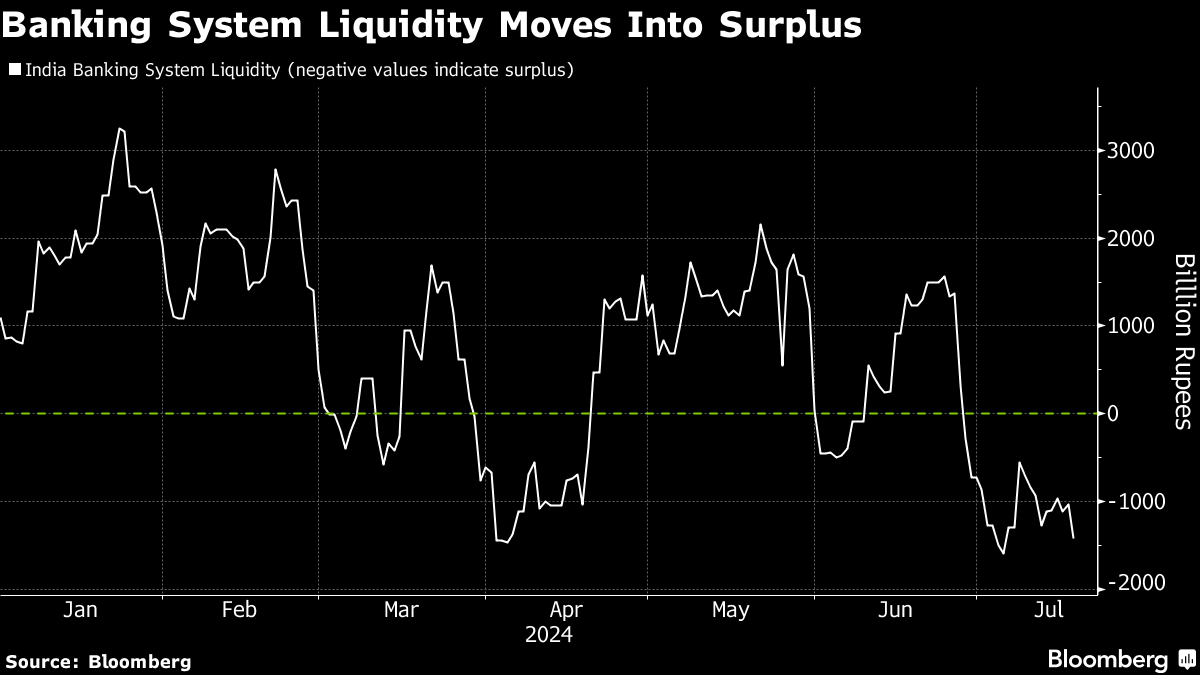
Liquidity in India's banking system moved into surplus in July, standing at about 1.4 trillion rupees ($16.7 billion) on Thursday. It has been in a small deficit for much of this year on RBI's tight grip as the central bank tried to tame inflation.
India had used MSS on previous occasions too, including after a 2016 cash ban to absorb a surge of liquidity in the banking system as citizens were forced to deposit high-value currency notes with banks. It was also deployed to drain out liquidity after the RBI eased conditions in response to the 2008 global financial crisis.
In the past, foreign investors hardly had a presence in India's bond market, but “today you are in an index,” said Radhakrishnan. “Tomorrow you might be part of many more indexes, the macro is getting better, so why should the central bank not have the tools?”
--With assistance from Subhadip Sircar.
More stories like this are available on bloomberg.com
©2024 Bloomberg L.P.
Essential Business Intelligence, Continuous LIVE TV, Sharp Market Insights, Practical Personal Finance Advice and Latest Stories — On NDTV Profit.